The question
What would the requirement cost drivers and carriers, what would it save them, and what would it do to the state economy?
What BEAR found
Direct costs average about $49 million a year over the decade, against about $306 million a year in benefits: $272 million in paperwork savings and $35 million in avoided crashes, a net direct benefit of $257 million a year.
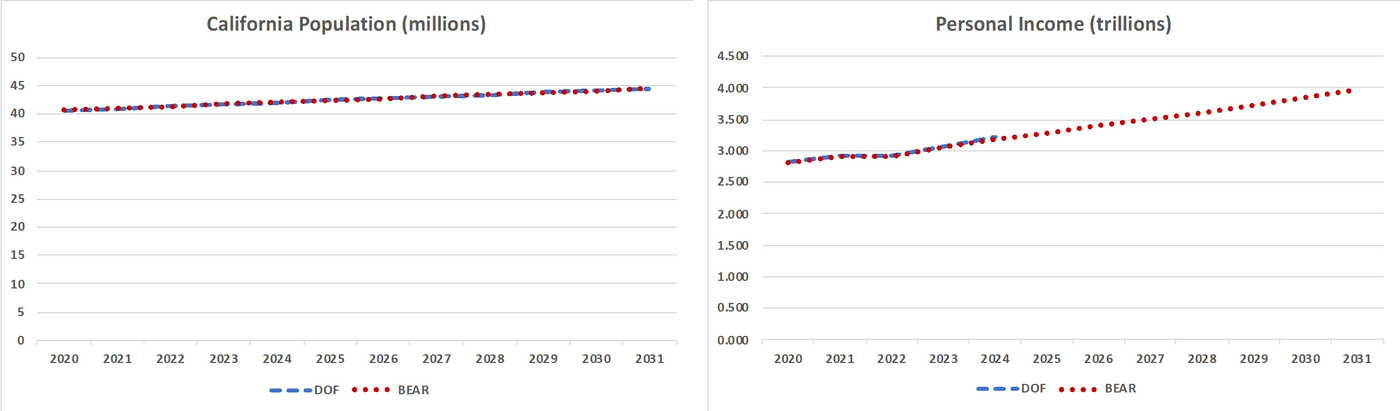
The economy gains an average of $548 million a year in gross state product and 9,112 full-time jobs, rising to $989 million and 14,687 jobs by 2031. The Department of Finance summary records the impacts as estimated using the BEAR forecasting model.
Method
The BEAR dynamic CGE model (60 sectors on 2018 IMPLAN data), run over 2022 to 2031 against the Department of Finance’s June 2021 conforming forecast. Direct costs and benefits were adapted from the federal FMCSA electronic logging device regulatory impact analysis and scaled to California.
Team
David Roland-Holst (project manager), Drew Behnke, Andrew Lee and Samuel Neal.
Public record
- SRIA as submitted to the Department of Finance (PDF)January 2022
- Department of Finance summary, form DF-131 (PDF)Names the BEAR forecasting model
- Department of Finance comment letter (PDF)March 3, 2022
- CHP intrastate electronic logging devices programchp.ca.gov
How to cite
Roland-Holst, D., Behnke, D., Lee, A., and Neal, S. (2022). Standardized Regulatory Impact Assessment: Electronic Logging Devices for Intrastate Motor Carriers and Drivers. Berkeley Economic Advising and Research. Prepared for the California Highway Patrol.