The question
What would the two rules cost the cardroom industry and the state economy, and how much play would shift to tribal casinos?
What BEAR found
Together the rules cut cardroom revenue by an estimated $464 million and raise tribal casino revenue by $232 million, a combined gross impact of $696 million. Real gross state product is $331 million a year below baseline on average over 2026 to 2035, with 364 fewer jobs a year.
The December 2024 revision, prepared after the Department of Finance’s comments, adds estimated losses of $95 million in local fee revenue and $14 million in state fee revenue.
Method
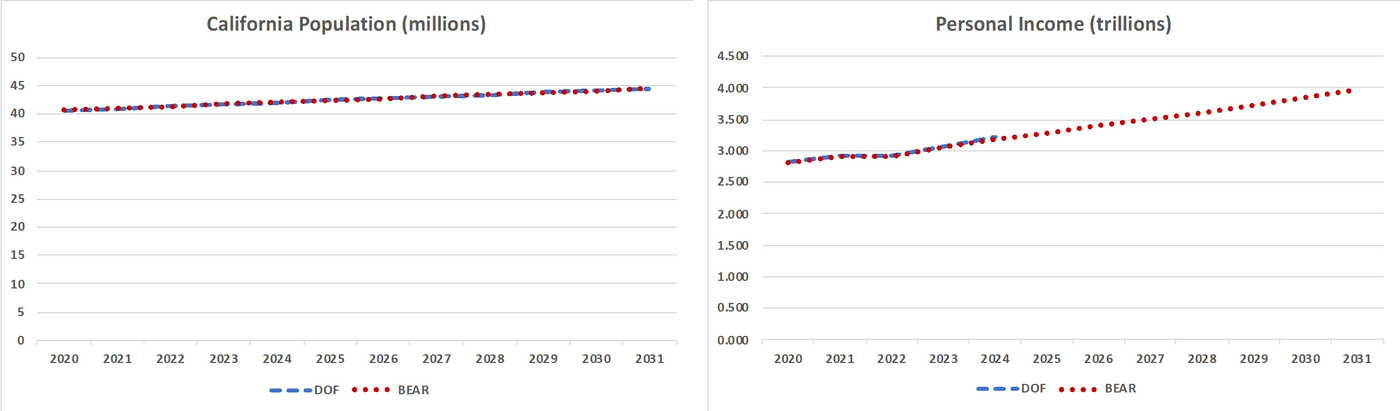
The BEAR dynamic CGE model (60 sectors on 2022 IMPLAN data), run over 2026 to 2035 against the Department of Finance’s July 2024 conforming forecast, with revenue-diversion scenarios for each rule and for both combined.
Team
Drew Behnke, Sam Heft-Neal and David Roland-Holst.
Public record
- Revised SRIA, Initial Statement of Reasons Appendix D (PDF)Office of the Attorney General, December 2024
- Original SRIA as submitted to the Department of Finance (PDF)August 2024
- Department of Finance comment letter (PDF)September 26, 2024
- Bureau of Gambling Control regulations pageoag.ca.gov
How to cite
Behnke, D., Heft-Neal, S., and Roland-Holst, D. (2024, revised December 2024). Standardized Regulatory Impact Assessment: Player-Dealer Rotation and Blackjack Regulations. Berkeley Economic Advising and Research. Prepared for the California Department of Justice, Bureau of Gambling Control.