




Livestock Traceability System for Lao PDR
Place: Lao PDR, PRC, Thailand • Dates: 2020-2026 • Partner: ADB
Increased cross-border livestock trade in the Greater Mekong Sub-region (GMS) is changing disease risk landscapes, including higher incidence of tainted meat and meat fraud in regional markets. As part of ADB’s TA 9916-REG: Greater Mekong Subregion Sustainable Agriculture and Food Security Program,”Enhancing Smallholder Cattle Value Chains through Digital Livestock Traceability (Output 2.2)” was implemented under in Lao PDR, covering a 730 km demonstration corridor spanning three northern provinces – Xayaboury, Oudomxay, and Luang Namtha – and six districts. The demonstration was implemented in association with Landell Mills Ltd , with the Lao Department of Livestock and Fisheries (DLF) as the primary national implementing partner.
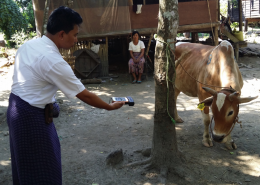
The Livestock Traceability Demonstration (LTD) assigns each animal a globally unique 13-digit ID, recorded via ear tag and mobile-phone scanning at key points in the supply chain: birth/registration, farm departure, market arrival and departure, border crossing, and slaughter. This trace-and-scan pathway feeds into a central livestock database accessible by value chain stakeholders and public sector institutions. Over the course of the project, a representative sample of 145 smallholder producers were recruited and trained in LTD system, 665 cattle tagged and registered, and over 50 local market intermediaries (transporters, traders, veterinarians, inspectors) were also trained and registered in the mobile based network.
The fourth and final phase of the LTD was directed toward an inclusive ex-post assessment of the current state of the traceability system. A direct, mobile-phone-based survey was conducted by DLF staff targeting all 110 value chain participants registered in the LTD database, with 78 completed responses recorded between November 2025 and February 2026.
In addition to more detailed information on patterns of GMS animal movements and disease reporting, our general finding is that conditions are ripe for improved oversight and trade facilitation. At the transboundary level, informal animal flows predominate in many areas, leading to higher transactions cots and significant uncertainties regarding health status and other product quality characteristics. These market failures promote adverse selection, limited supply chain engagement, and underinvestment, undermining public trust and leaving this category of regional agrifood development far below its potential to contribute to regional livelihoods. More specifically, the experience of the three country LITS pilots support the following policy recommendations:
- As regional integration progresses, GMS countries are facing dramatically changing agrifood market opportunities. To capture these effectively will require determined policy support for market access and supply chain modernization.
- Agrifood market expansion can be a potent catalyst for poverty reduction if policies support adoption of appropriate technologies and institutions. In the GMS, these include e-Traceability, certification, contracting, and producer cooperatives.
- Expanding agrifood markets present new opportunities and risks to the region, as increasingly diverse biological products and economic agency complicate the food safety landscape. Managing food safety, disease, and other risks will require technological modernization, including e-traceability to improve supply chain transparency and product quality accountability.
- Partnership with private sector actors can accelerate and reduce the public costs of supply chain modernization. Technologies like e-Traceabilty enhance private value and adoption/diffusion of these innovations can be self-financing if governments take a leadership role in establishing and administering standards.
- Regional government partnership for harmonized standards and adoption is essential to the credibility and effectiveness of supply chain technologies. Many of the potential benefits (e.g. product safety) of e-traceability cannot be sustained without transboundary coordination.
- Global trade partners, especially in the larger and more advanced economies, have strong incentives to support GMS agrifood modernization, and the sub-regional governments and their private sector agents should take full advantage of this to promote joint ventures, technology transfer, and export market access.
- This project demonstrates that modest initial public investments can be leveraged by low-cost use technologies to significantly improve supply chain performance and participation. GMS governments and their development partners should follow this example of innovation leadership and continue making targeted investments to overcome information-based market access barriers.
- The internet database platform developed for this project demonstrates its potential for universal information access. This presents opportunities for market transparency, but it also raises policy issues that should be addressed regarding privacy.
- The successful implementation and positive reception of the LTD cattle pilots indicates that they should be expanded to national programs, not only in the three countries studied, but across the GMS.
- Based on global experience with a wide array of other traceable agrifood products, the LTD results also indicate that e-traceability should be expanded to pilots for other animals including fish, fruits and vegetables, timber products, and many other live and processed agrifood products.
Most Recent Entries
A Social Network for Mongolian Cashmere Producers
Livestock Traceability System for Lao PDR