



Extending Service of the Diablo Canyon Nuclear Power Plant: An Economic Impact Assessment
Place: California • Date: July, 2026 • Partner: PG&E
Operations of the Diablo Canyon Nuclear Power Plant (DCPP) were extended through 2030 in response to the growing risk of electricity shortfalls and blackouts, and slower-than-expected deployment of replacement renewable energy. As a matter of diligence to support its strategic planning, stakeholder engagement, and public information, PG&E commissioned this assessment of the expected impacts of extended DCPP operation on the local, state, and regional economy.
This assessment makes two primary contributions to strategic planning, public and private information, and constructive energy policy dialog. The first of these is informational – a general overview of economic issues related to extension DCPP operations. This occupies much of the narrative background in the report. The second contribution is technical – a rigorous analysis of three main dimensions of DCPP impact on the local and state economies.
Economic Impact Assessment
Generally, this economic impact assessment finds that DCPP operations are a potent and inclusive catalyst for growth. Our analysis shows how DCPP operations confer and diverse and significant array of economic benefits across their host counties and the state economy generally. Using the latest and most detailed data available, combined with advanced economic impact assessment tools, it demonstrates how continued operation of DCPP will create hundreds of millions of dollars in additional income and support thousands of jobs outside the energy sector. Moreover, regardless of the status of prior DCPP targeted tax and prior fee arrangements, DCPP operations contribute (directly and indirectly) more than $80 million in combined state and local taxes and over $160 million in Federal taxes.
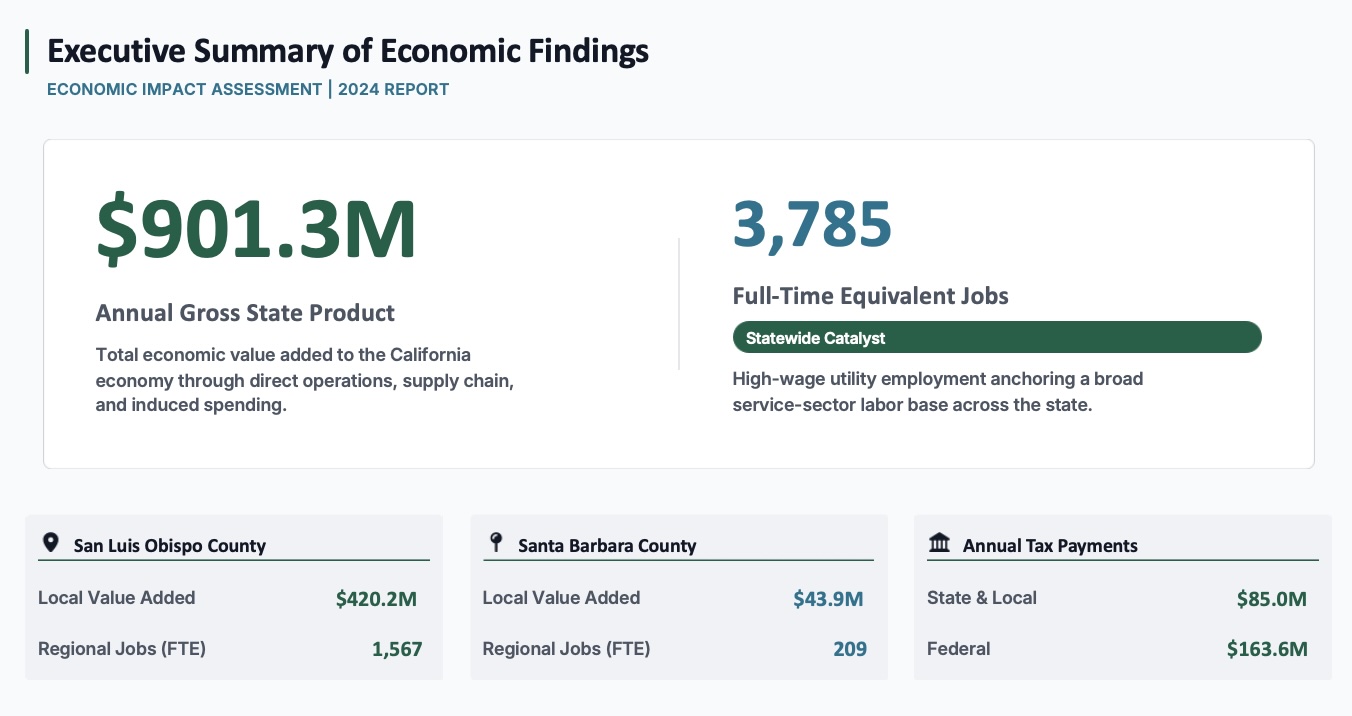
Screenshot
Real Estate Market Assessment
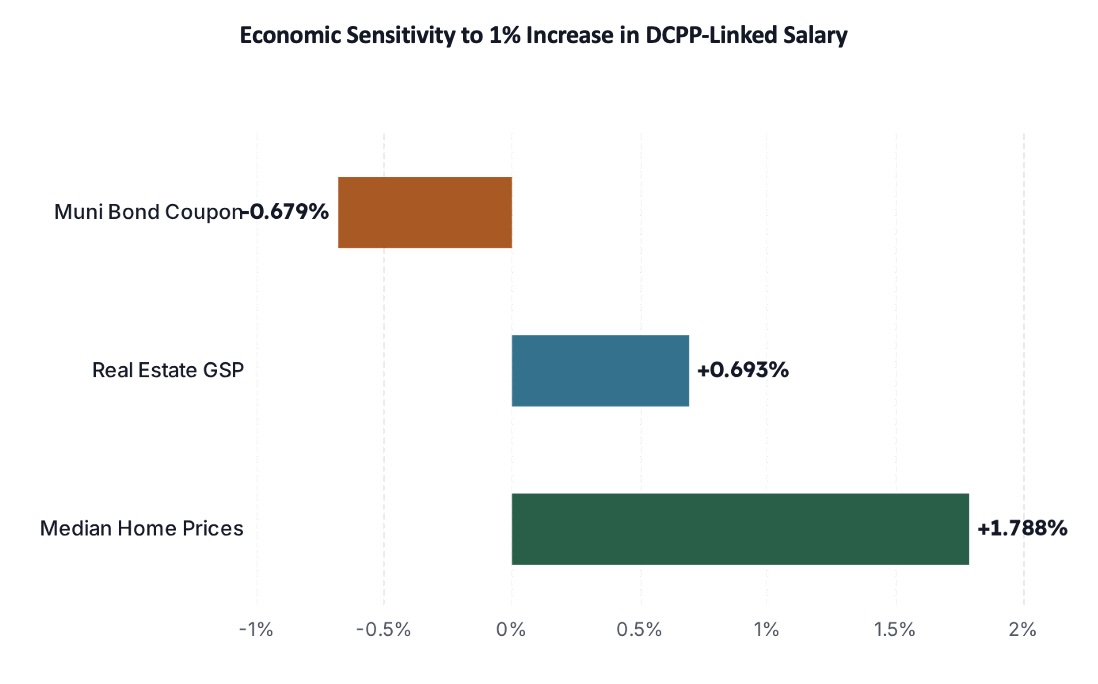
Because it is a major local employer with relatively high wage workers, DCPP operations have important spillover effects on property values. For this reason, every significant economic assessment of DCPP operations has addressed the issue of real estate market effects. This section reviews the general issues involved and presents a more technical analysis to support generally positive conclusions regarding DCPP’s contribution to sustaining property values, the core asset for most American households. The same forces also support provision of many public and private goods and services associated with higher value residential communities.
Screenshot
Bond Market Assessment
Among the many potential economic impacts of the prospective DCPP closure, one of the most scrutinized was its fiscal implications for the various government institutions of San Luis Obispo County. When economic sentiment about a regional economy turns negative, bond markets react by pricing higher anticipated risk into bond rates. In some cases, the effects of this on overall public budgets can be greater than the loss of individual revenue sources. Because the cost of capital affects the entire budget of local public entities, these “second order” risk effects are potentially as significant as the direct, indirect, and induced revenue impacts of the DCPP closure. Conversely, the continued operation of a large and economically robust, high income employer can improve investor sentiment and lower bond rates in local markets.
And indeed, we observe a general increase in yield spread when we look at counties not directly affected by event announcement (see the figure below). Thus, in order to determine whether there was an additional increase for bonds within SLO County, relative to the comparison counties which should be relatively unaffected by this announcement, it is important to use the difference-in-differences technique mentioned previously.

A Social Network for Mongolian Cashmere Producers

Livestock Traceability System for Lao PDR